


We have put a map of the Shrine after the text.
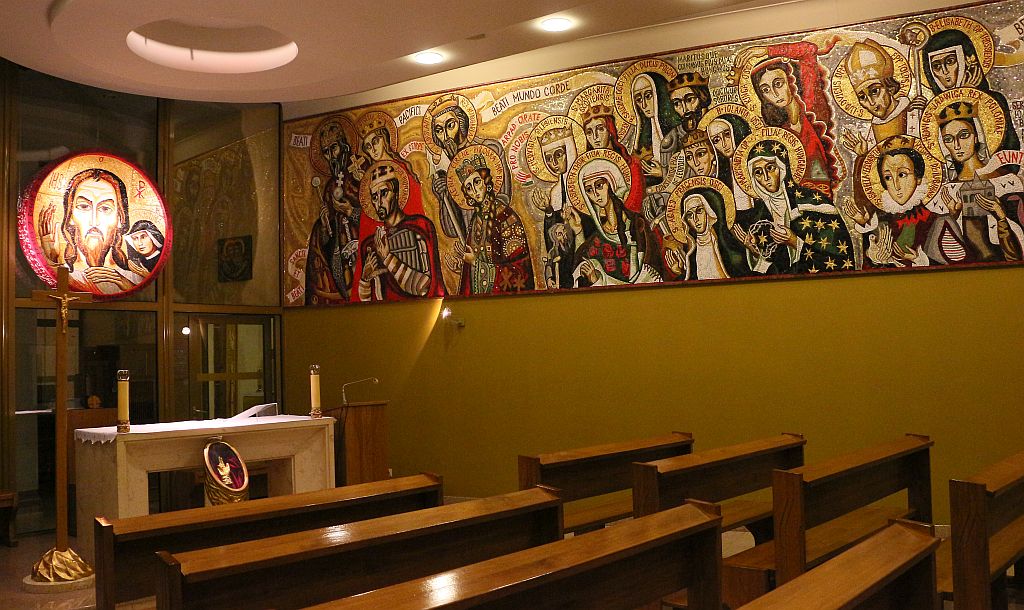
As you enter the Lower Basilica and walk towards St. Faustina’s Chapel, the Communio Sanctorum Chapel will be on the right. This Chapel was consecrated in 2004 by Cardinal Péter Erdó, Primate of Hungary, and Cardinal Franciszek Macharski, Metropolitan Archbishop of Kraków. Its interior decoration is the gift of the Church in Hungary, and that is why it is also known as the Hungarian Chapel. Its side walls are decorated with a splendid series of mosaics depicting over 60 saints and blesseds from Hungary, Poland, and other European countries who have contributed some of the finest chapters in the history of the Church. They are grouped in separate clusters, and each cluster is inscribed with one of the Eight Beatitudes from the Sermon on the Mount, giving a commentary on their lives. This procession of saints is headed by Mary, the Mother of God. Over the marble altar there is a mosaic showing the Merciful Jesus and St. Faustina, circumscribed with the words Jesus, I trust in You in several languages. In front of the altar there is a reliquary in the shape of a right hand containing a relic of St. Stephen, Patron Saint of Hungary. The Chapel’s interior decoration was designed and made by the Hungarian artist Father László Puskás, who is a Uniate Greek Catholic priest, and his wife.
The Chapel’s name and its interior decoration allude to the fundamental vocation to which we are all called, that is sanctity, uniting with God in this life and in eternity. St. Faustina wrote that ever since her youngest years she had always wanted to be a great saint, that is to love Jesus with so great a love as no other person had loved Him before. “At first it was a secret wish of mine, which only Jesus knew. Today I cannot keep it in my heart; I’d like to shout it out to the whole wide world: love God, for He is good and great is His mercy” (Diary 1372). For millions all over the world, she is the model of a perfect life, and Jesus assured her that “The greatest of sinners would become great saints, if only they would trust in My mercy. . . . It gives Me great pleasure to work in the human soul, fill it with My mercy [133] and justify it. My Kingdom on Earth is My life in the human soul. Secretary of Mine, write down that I Myself am the spiritual director of souls, but indirectly I lead them with the help of one of my priests, and each of them I lead to sanctity along a path known only to Myself” (Diary 1784).
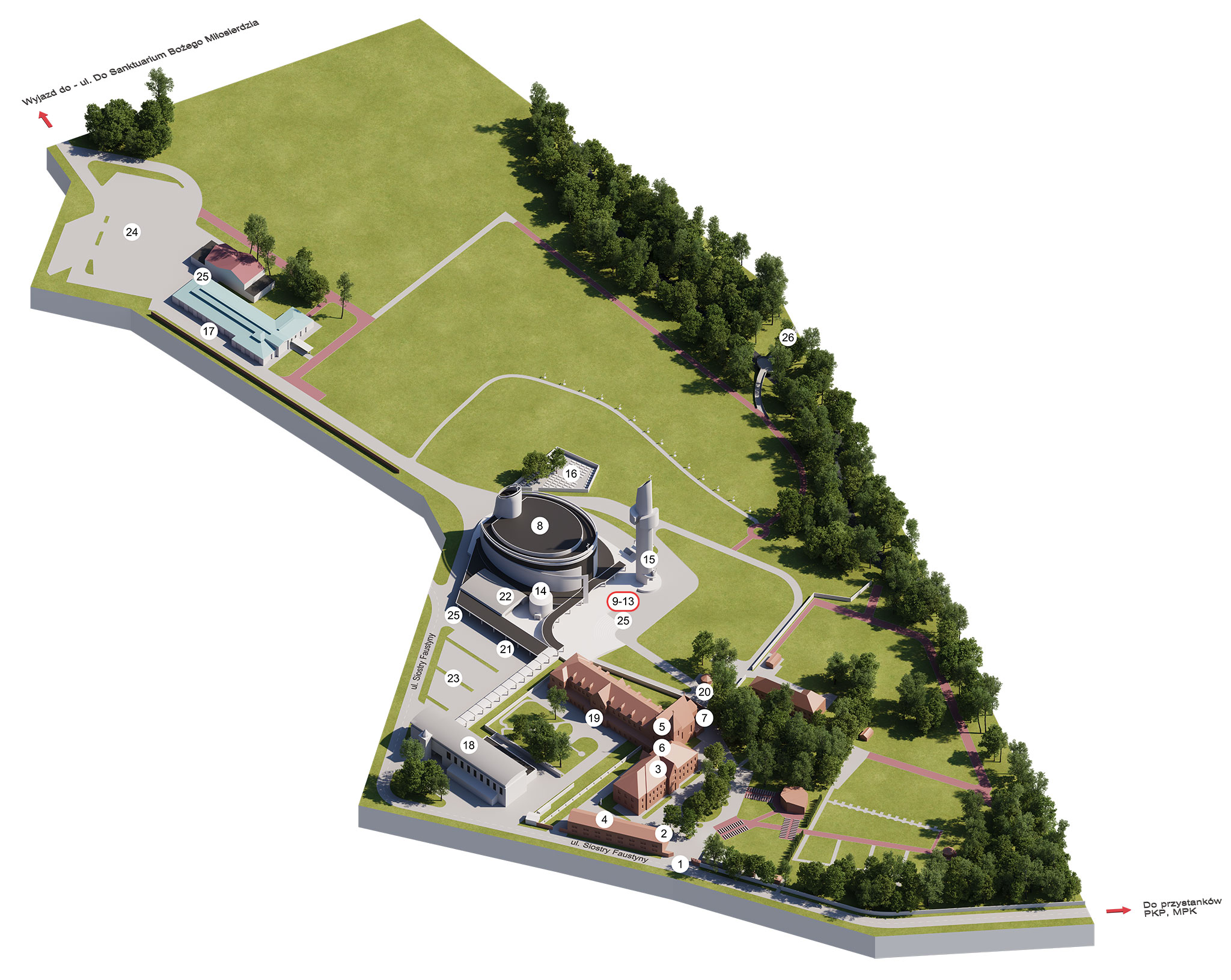
- Main entrance to the Shrine
- Sister Faustina’s House: hotel & museum
- Convent
- Antoninek House: Faustinum Association
-
Merciful Jesus Chapel & Saint Faustina’s Tomb: Heart of the Shrine
- Oratory: room where Saint Faustina died
- Chapel of the Lord’s Passion
- Divine Mercy Basilica
- Saint Faustina’s Chapel
- The Communio Sanctorum Chapel
- Saint Andrew’s Chapel
- The Holy Cross Chapel
- The Chapel of Our Lady of the Seven Sorrows
- Perpetual Adoration Chapel
- Viewing Tower
- Convent Graveyard
- Sister Faustina’s House: restaurant, souvenirs & meeting hall
- Pastoral Lodge: hotel & restaurant
- Mercy House
- Information Booth
- Souvenirs & Misericordia Bookshop
- Saint John Paul II Hall
- Car park
- Car and coach park
- Toilets
- Bridge of Mercy, for the Saint John Paul II Shrine & tram stop